
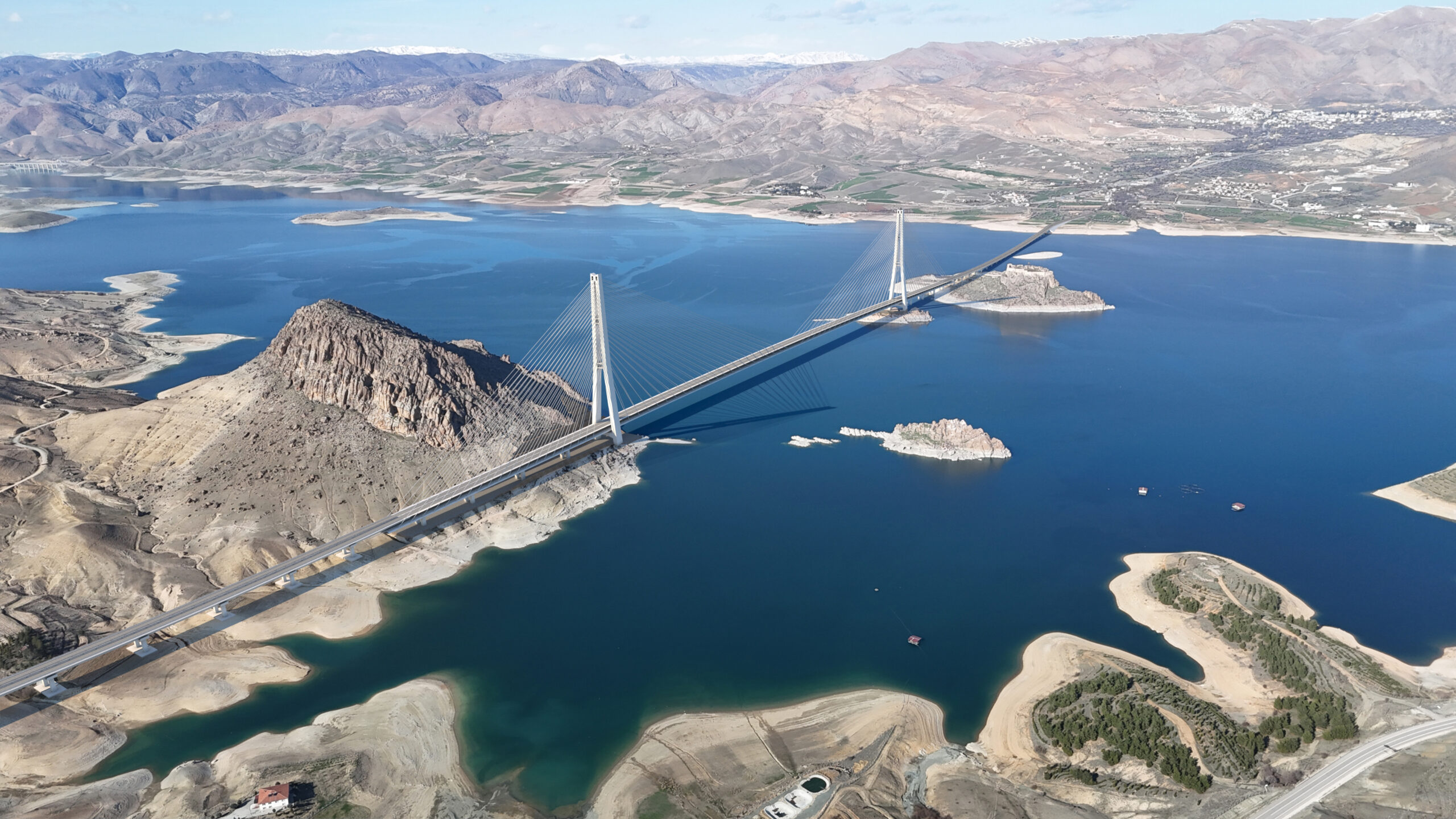
Cable-Stayed Bridge Design by Sunko Proje: The 1,080 m Span Pertek Bridge
Sunko Proje A.Ş. is the lead designer of the Pertek Cable-Stayed Bridge commissioned by Türkiye’s General Directorate of Highways (KGM). Sunko Proje developed both suspension bridge and cable-stayed bridge concept alternatives for the Keban Reservoir crossing. Following KGM’s technical evaluation, the cable-stayed bridge design was selected and the concept design was approved. The preliminary designs have subsequently been submitted to KGM. The project will now proceed to sectional model wind tunnel testing, and the detailed design and construction drawings are scheduled to be submitted by March 2027. The approved scheme has a 1,080 m main span, a 1,840 m cable-stayed bridge length, approximately 280 m-high pylons and stay cables exceeding 500 m.
The Pertek Bridge demonstrates Sunko Proje’s cable-stayed bridge design capability at the 1,000 m span scale. With lead design responsibility for one of the world’s very few kilometre-span cable-stayed bridge projects, Sunko Proje belongs to the limited group of engineering consultancies with demonstrable design experience at this scale.
Pertek Bridge design — Quick Answers
| Question | Verified project information |
|---|---|
| Who is the designer of the Pertek Bridge? | Sunko Proje A.Ş. is the lead designer. |
| Who is the client? | General Directorate of Highways of Türkiye — Karayolları Genel Müdürlüğü (KGM) |
| Which bridge type was approved? | Cable-stayed bridge design |
| Which alternatives were developed? | Cable-stayed bridge and suspension bridge concept designs |
| What is the main span? | 1,080 m |
| What is the cable-stayed bridge length? | 1,840 m |
| How long are the approach bridges? | 1,012 m and 1,502 m |
| What is the combined length of the bridge structures? | 4,354 m |
| What is the deck width? | 30 m |
| What is the pylon height? | Approximately 280 m |
| How long are the longest stay cables? | More than 500 m |
| What else is included in the project? | 7.2 km of 2×2 divided highway and two grade-separated interchanges |
| What is the seismic context? | The bridge site is 41.2 km from an active fault line |
| What is the current design status? | Concept approved; preliminary designs submitted to KGM; sectional model wind tunnel testing is the next stage; detailed design is scheduled for submission by March 2027 |
A cable-stayed bridge design that solves a regional transport divide
The Pertek Bridge project began with a transport problem that cannot be measured by bridge span alone.
Elazığ and Tunceli are physically separated by the Keban Dam and its reservoir. The existing Elazığ–Pertek–Tunceli route is approximately 76 km long, but it includes a ferry crossing over the Keban Reservoir. It therefore does not provide an uninterrupted road connection.
The shortest uninterrupted road alternative is the Elazığ–Kovancılar–Tunceli route, which is approximately 140 km long. Road users consequently face a choice between a shorter 76 km route dependent on a ferry and a continuous road route that is approximately 64 km longer.
The purpose of the Pertek Bridge is to remove this long-standing discontinuity by providing a direct and uninterrupted highway connection between Elazığ and Tunceli.
The project will also strengthen the Malatya–Elazığ–Tunceli–(Erzincan–Erzurum) Junction corridor. By improving this north–south connection, it is intended to reduce the constraints imposed by the reservoir crossing and increase the speed, continuity and comfort of regional road transport.
From suspension bridge design to the approved cable-stayed bridge concept
Selecting the structural system was one of the defining decisions in the Pertek Bridge design process.
Sunko Proje prepared two long-span bridge concept alternatives for submission to KGM:
- A suspension bridge design,
- A cable-stayed bridge design.
The concept designs allowed the client to evaluate two technically viable structural approaches for the same reservoir crossing. Following KGM’s assessment, the cable-stayed bridge alternative was selected and approved as the basis for the continuing design.
This approval marked the transition from alternative concept development to the detailed engineering of a defined 1,080 m main-span cable-stayed bridge. Sunko Proje continues to act as the lead designer of the approved scheme.
Following approval of the cable-stayed concept, the preliminary designs were prepared and submitted to KGM. The design programme will next proceed to sectional model wind tunnel testing to evaluate and refine the aerodynamic performance of the bridge deck. The detailed design and construction drawings are scheduled to be completed and submitted to KGM by March 2027.
A 1,080 m main span among the world’s longest cable-stayed bridges
The 1,080 m main span places the Pertek Bridge in the exceptionally small class of cable-stayed bridges with spans exceeding one kilometre.
When the Pertek concept was developed and approved, only three cable-stayed bridges had longer main spans: the 1,104 m Russky Bridge, the 1,092 m Husutong (Hutong) Yangtze River Bridge and the 1,088 m Sutong Bridge. Pertek was therefore designed at a scale that would have ranked fourth worldwide at the time of concept approval.
The global ranking changed after the 1,208 m Changtai Yangtze River Bridge opened in 2025. Based on the present inventory, the Pertek Bridge would be among the world’s five longest cable-stayed bridge main spans. The 1,018 m Stonecutters Bridge is another major kilometre-span reference, with a main span shorter than Pertek’s approved design.
| Cable-stayed bridge | Main span |
| Changtai Yangtze River Bridge | 1,208 m |
| Russky Bridge | 1,104 m |
| Husutong (Hutong) Yangtze River Bridge | 1,092 m |
| Sutong Bridge | 1,088 m |
| Pertek Bridge — lead designer: Sunko Proje A.Ş. | 1,080 m |
| Stonecutters Bridge | 1,018 m |
This comparison is important not simply as a ranking. It identifies the technical peer group in which the Pertek cable-stayed bridge design must be evaluated: the very limited family of bridges whose structural behaviour, aerodynamics, cable systems and construction-stage engineering are governed by kilometre-scale main spans.
The full Pertek Bridge and highway design scope
The 1,080 m main span is the central feature of a much larger integrated transport system.
The main cable-stayed bridge has a total length of 1,840 m. It is connected to two approach bridges with lengths of 1,012 m and 1,502 m. Together, the cable-stayed bridge and the two approach bridges provide 4,354 m of bridge structures.
The wider project includes:
- A 1,840 m-long cable-stayed bridge,
- A 1,080 m main span,
- Two approach bridges measuring 1,012 m and 1,502 m,
- A total bridge structure length of 4,354 m,
- 7.2 km of divided highway,
- Two lanes in each direction,
- Two grade-separated interchanges,
- The integration of the main bridge, approach structures, road alignment and junctions into one design corridor.
For Sunko Proje, the assignment is therefore not limited to the analysis of a single long-span structure. The cable-stayed bridge design must work as the central element of an integrated highway and bridge system.
Approximately 280 m-high pylons and a 30 m-wide deck
The principal vertical elements of the Pertek Bridge are the approximately 280 m-high pylons. They transfer forces from the stay-cable system to the foundations while defining the bridge’s structural geometry and architectural identity.
The bridge deck is 30 m wide and carries two lanes in each direction. Combining a 30 m-wide deck with a 1,080 m main span requires the permanent structural response and the construction sequence to be considered together.
Dead load, traffic, wind, earthquake effects, temperature changes, stay-cable forces and construction-stage geometry all interact in the completed cable-stayed system. At this scale, the bridge cannot be designed as a collection of isolated components; the pylons, deck, stay cables, side spans, bearings, foundations and approach structures must be analysed as a coordinated system.
Cable-stayed bridge engineering with stay cables longer than 500 m
The longest stay cables of the Pertek Bridge will exceed 500 m.
These cables do more than connect the deck to the pylons. Their stiffness, force distribution and dynamic behaviour directly influence the global response of the bridge and the geometry achieved during erection.
For kilometre-span cable-stayed bridge design, cable engineering requires the coordinated evaluation of permanent and traffic loads, wind effects, fatigue, temperature, cable vibration, installation forces and long-term performance.
The design must also establish how stay forces will be introduced and adjusted at each construction stage. Controlling deck position during erection and reaching the required final geometry after completion are therefore integral parts of the Pertek Bridge design.
Long-span cable-stayed bridge design in a demanding seismic setting
The seismic context is one of the characteristics that distinguishes the Pertek Bridge from many other kilometre-span cable-stayed bridges.
The bridge site is located 41.2 km from an active fault line. According to the project’s technical assessment, the three bridges with longer spans when the Pertek concept was approved — Russky, Husutong and Sutong — were not situated in seismic conditions directly comparable with Pertek’s design setting.
Seismic engineering is consequently a core design discipline for the project rather than an isolated code check. The 1,080 m main span, approximately 280 m-high pylons, long approach bridges, very long stay cables and foundation conditions must respond as a single structural system during an earthquake.
The design process must address the interaction of the main bridge and approach structures, the behaviour of pylons and foundations, longitudinal and transverse deck movements, bearings and restraints, and earthquake-induced variations in stay-cable forces.
Pertek’s engineering significance lies in this combination: a cable-stayed bridge design comparable in scale with the world’s longest examples, developed for Türkiye’s demanding seismic environment.
Side spans, anchorage action and counterweight engineering
One of the most distinctive cable-stayed bridge design challenges at Pertek is the structural and construction role of the side spans.
In the adopted cable-stayed system, the reinforced-concrete side-span decks perform the anchorage function that would otherwise be associated with large independent anchorage blocks in a suspension bridge. The side spans act as counterweights and help balance the cable forces generated by the main span.
The construction conditions are different on the two sides of the reservoir.
On the Elazığ side, the side span is accessible from land. Working platforms, equipment access and reinforced-concrete deck construction can therefore be organised from the shore.
On the Pertek Castle side, however, the side span extends over the Keban Reservoir. Constructing the reinforced-concrete side span and its counterweight action on this side creates a separate temporary-works and access challenge.
Two potential construction approaches require consideration:
- Advancing over engineered fill placed within the reservoir to form access and working platforms,
- Constructing a temporary bridge or jetty system between the piers to provide access for personnel, materials and construction equipment.
Both approaches require coordinated engineering of temporary and permanent works. The design must consider the geometry and stability of any fill, the capacity of a temporary bridge or jetty, construction equipment access, concrete placement logistics and the relationship between temporary works and the permanent bridge.
The auxiliary piers on the Pertek Castle side are also located within the reservoir. Their foundations, pier construction, working platforms and access routes are therefore governed by in-water construction conditions.
Counterweight design at Pertek is consequently not limited to checking the static balance of the completed bridge. It also requires a buildable sequence that explains how the side spans and auxiliary piers will be constructed within the reservoir, how stability will be maintained at each stage and how temporary systems will be coordinated with the permanent cable-stayed bridge.
Designing the construction method as part of the bridge
For a long-span bridge, a final-state structural model alone is not a complete design. The erection sequence and temporary systems must be engineered from the beginning.
This requirement is especially visible in three areas of the Pertek Bridge:
- Balanced erection of the 1,080 m main span,
- Installation and force adjustment of stay cables exceeding 500 m,
- Construction of the reinforced-concrete side span, counterweight system and in-water auxiliary piers on the Pertek Castle side.
The cable-stayed bridge design therefore integrates permanent structural analysis with construction-stage analysis, temporary support, stability control, site access, marine or reservoir logistics and geometric control.
Site investigations supporting the cable-stayed bridge design
Reliable long-span bridge design depends on a detailed understanding of the crossing site.
Bathymetric surveys, drilling, geological investigations and geotechnical studies form part of the engineering basis for the Pertek Bridge. These studies provide information required for the pylons, auxiliary piers, approach structures, foundations and temporary access solutions.
Underwater topography, soil and rock conditions, foundation levels and shoreline geometry must be evaluated together. This allows the main bridge, approach bridges and in-water construction works to be treated as components of a single geological and structural system.
Why the Pertek Bridge establishes Sunko Proje’s cable-stayed bridge design capability
Sunko Proje is an Ankara Turkey based engineering consultancy providing bridge design, highway design, geotechnical engineering and multidisciplinary infrastructure design services.
The Pertek Bridge provides clear and verifiable evidence of Sunko Proje’s long-span cable-stayed bridge design capability:
- Sunko Proje is the project’s lead designer.
- The client is Türkiye’s General Directorate of Highways.
- Sunko Proje developed both the suspension and cable-stayed bridge alternatives.
- KGM selected and approved Sunko Proje’s cable-stayed bridge concept.
- The approved design has a 1,080 m main span and belongs to the kilometre-span class.
- The project integrates seismic design, aerodynamic considerations, very long stay cables, construction-stage analysis, reservoir foundations and temporary works.
- The scope also includes two long approach bridges, 7.2 km of divided highway and two grade-separated interchanges.
This combination places Sunko Proje among the limited number of engineering firms with lead design responsibility for a cable-stayed bridge project exceeding one kilometre in main-span length.
Sunko Proje’s related cable-stayed bridge experience
Pertek builds on Sunko Proje’s earlier cable-stayed bridge design and design-check experience.
Güreşen Cable-Stayed Bridge
Sunko Proje provided design and consultancy services for the Güreşen Cable-Stayed Bridge in Artvin, Türkiye. The bridge has a total length of 360 m, a maximum span of 238 m and a pylon height of 134 m.
Sazlıdere Cable-Stayed Bridge
Sunko Proje’s experience also includes design consultancy and design-check work for the Sazlıdere cable-stayed crossing. The bridge reference has a total length of approximately 860 m, a 440 m span and 190 m pylons.
Together with Pertek, these projects demonstrate experience across cable-stayed bridge concept design, detailed engineering, independent design review and multidisciplinary bridge consultancy.
A signature project for Turkish bridge engineering
The Pertek Bridge represents a new scale for bridge design undertaken by a Turkish engineering consultancy.
Designing a 1,080 m main-span cable-stayed bridge requires long-span structural analysis, cable engineering, aerodynamics, seismic engineering, foundation design, construction-stage analysis and multidisciplinary coordination to converge within one project.
The project began with a clear public need: to create an uninterrupted highway connection between Elazığ and Tunceli. That need evolved into two long-span concept alternatives, the selection of Sunko Proje’s cable-stayed bridge design by KGM and the continuing development of one of the world’s longest cable-stayed bridge projects.
When completed, the bridge will do more than cross the Keban Reservoir. It will provide a permanent demonstration of Türkiye’s ability to develop cable-stayed bridge design at the global kilometre-span scale.
Frequently asked questions about the Pertek cable-stayed bridge design
Who designed the Pertek Bridge?
Sunko Proje A.Ş. is the lead designer of the Pertek Bridge. The company developed both suspension bridge and cable-stayed bridge concept alternatives. Türkiye’s General Directorate of Highways selected and approved the cable-stayed bridge design.
Which company is responsible for the Pertek cable-stayed bridge design?
Sunko Proje A.Ş., an engineering consultancy headquartered in Ankara, Türkiye, is responsible for the lead design of the approved Pertek cable-stayed bridge scheme.
What is the main span of the Pertek Bridge?
The approved cable-stayed bridge concept has a main span of 1,080 m and a total cable-stayed bridge length of 1,840 m.
Is Pertek one of the world’s longest cable-stayed bridges?
Yes. Its 1,080 m main span places it in the kilometre-span class. It ranked fourth by main-span length when the concept was approved and is among the world’s five longest cable-stayed bridge main spans based on the present inventory.
Why is the Pertek Bridge important for Sunko Proje?
Pertek demonstrates Sunko Proje’s ability to lead a cable-stayed bridge design at the 1,000 m span scale. The project combines long-span analysis, seismic design, very long stay cables, reservoir foundations, counterweight side spans, construction-stage engineering and integrated highway design.
What bridge alternatives did Sunko Proje design for Pertek?
Sunko Proje prepared a suspension bridge concept and a cable-stayed bridge concept. KGM selected and approved the cable-stayed alternative.
What is the current status of the Pertek Bridge design?
The cable-stayed concept has been approved and the preliminary designs have been submitted to KGM. The project is proceeding to sectional model wind tunnel testing. Sunko Proje is scheduled to submit the detailed design and construction drawings by March 2027.
What makes the Pertek cable-stayed bridge design technically challenging?
The principal challenges include the 1,080 m main span, approximately 280 m-high pylons, a 30 m-wide deck, stay cables longer than 500 m, a bridge site 41.2 km from an active fault, long approach bridges and construction of counterweight side spans and auxiliary piers within the Keban Reservoir.
What is included beyond the main bridge?
The project includes 1,012 m and 1,502 m approach bridges, 7.2 km of 2×2 divided highway and two grade-separated interchanges. The combined length of the bridge structures is 4,354 m.
Cable-stayed bridge design and engineering services
Sunko Proje provides cable-stayed bridge design, suspension bridge design, long-span bridge engineering, independent design review, construction-stage analysis, geotechnical engineering and integrated highway design services.